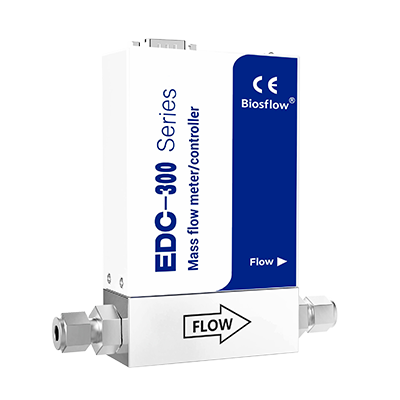
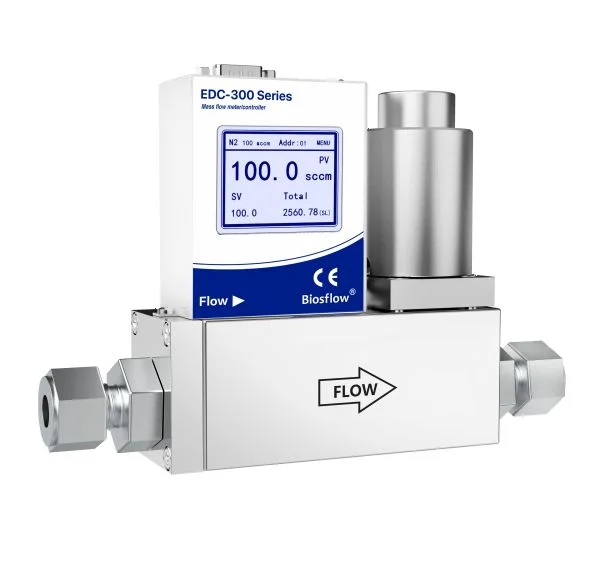
EDC-300 Series Mass Flow Controller and Meters
- Full Scale Flow Range(3sccm-1000slm)
- Maximum working pressure up to 1500 Psi
- High precision measurement and control
- High pressure differential adaptability
- Unaffected by temperature and pressure
- Quick response, high repeatability
- Digital communication, compatible with analog communication
- Optional real-time display with LCD screen
A massflow controller, also known as a mass flow regulator, is a precision instrument. It measures and actively controls the flow of gases or liquids. While ordinary MFC flow meters simply display readings, a mass flow controller not only shows the flow rate but also automatically adjusts it to maintain a steady preset value—even when system pressure fluctuates or temperature changes. Biosflow specializes in high-precision gas mass flow control.With the growth of MFC’s market share, understanding what drives MFC pricing is more relevant. So, when choosing an MFC device, several key factors affect the mass flow controller price. Let’s break them down one by one.
1. Full-Scale Range—The Bigger the Flow, the Higher the Price
Full-scale range is the primary factor determining the mass flow controller price. In other words, think of it like buying a pipe—the wider the pipe, the more material it takes, and consequently, the more it costs.
MFCs come with flow capacities ranging from as low as 3 SCCM (standard cubic centimeters per minute) all the way up to 1,500 SLPM (standard liters per minute). As the flow rate increases, the price goes up accordingly. In other words: higher flow rates require larger sensors, bigger valves, and more robust internal components.
Whether you require ultra-low sccm mass flow for delicate lab work or high-volume gas mass flow for industrial production, Biosflow offers a comprehensive portfolio of mass flow controller models to meet your specific needs. There is always a model that fits your application.
2. Technology Principle
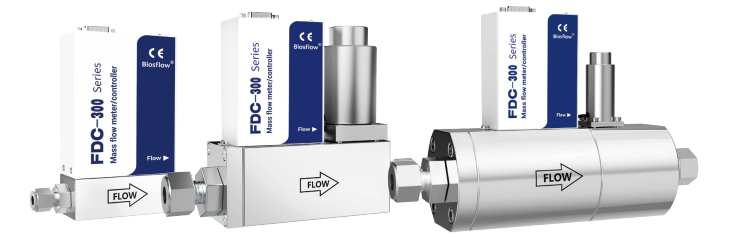
The mass flow controller price depends heavily on its underlying technology. Common types include thermal massflow controllers, pressure-based flow controllers, Coriolis massflow controllers, electromagnetic flow controllers, and so on. Each has its own strengths, weaknesses, and cost structure.
Thermal massflow controllers dominate the market. They work by measuring how much heat is carried away by the flowing gas—the more gas flows, the more heat is lost. Why are they so popular? First, they provide rapid response times and consistent repeatability. Moreover, they offer long-term durability even in demanding process environments. Finally, they do not require additional pressure and temperature compensation, which significantly simplifies system design.
Biosflow massflow controller adopts thermal massflow controller technology, combining capillary thermal differential sensing with laminar flow differential pressure technology. This integration not only delivers exceptional stability, linearity, but also dynamic response, backed by world-leading fluid engineering.
Compared to other mass flow controller manufacturers like Bronkhorst, Alicat, or Horiba, Biosflow has its own factory. This allows us to offer high quality at a better price. Additionally, Biosflow provides digital gas flow controller options that support multi-gas switching, real-time monitoring, and multiple digital communication protocols (such as Modbus, RS485). These smart features add value and functionality, making the device more versatile for modern automated systems.
| Performance | |
|---|---|
| Flow Accuracy | ±0.8% R.D and±0.2% F.S; ±1% R.D and ±0.5% F.S(>100 SLM) |
| Repeatability | ±0.2% F.S |
| Control Range | 1~100% F.S |
| Response Time | <1s |
| Temperature Coefficient | Zero: <0.05% of F.S./℃. Span: <0.1% of S.P. /℃ |
| Pressure Coefficient | 0.2% of S.P. / Bar |
| Operating Temperature | 0~50℃ |
| Leak Rate | 1x10⁻⁹ atm. cc/sec He |
| Preheat Time | 5 min accuracy to ±2% F.S (30 min to achieve the best accuracy) |
| Power Supply | +15~24 V DC |
| Maximum Power Consumption | 10W (MFC); 3W (MFM) |
| Digital Communication | RS-485(Modbus Rtu protocol) |
| Analog Communication | 0~5 V / 4~20mA |
| Electrical Interface | 9-Pin D-connector (Male) |
| Valve Type | Normally closed (MFM meaningless) |
| Substrate Material | 316L stainless steel |
| Sealing Material | Fluorine rubber, EPDM rubber, nitrile rubber |
| Process connections | Tube/VCR Fittings |
3. Gas Type
Biosflow mfc gas flow support a wide range of gases, including corrosive gases, gas mixtures, and toxic gases. Processing specialty gases often requires exotic materials (such as Hastelloy) and specialized seals, which increase the mass flow controller price compared to products designed solely for air or nitrogen.
For example, if you’re working with highly corrosive gases like chlorine or hydrogen chloride, the internal components need to be made from Hastelloy or other corrosion-resistant alloys. Standard stainless steel just won’t cut it—it would corrode over time, leading to leaks, inaccurate readings, and ultimately equipment failure. Similarly, the seals (O-rings) need to be made from special materials like Epdm or Kalrez that can withstand aggressive chemicals.
These material upgrades add high costs to both raw materials and manufacturing. But they’re essential for ensuring safety, reliability, and longevity in harsh environments.
Whether you need an air mass flow controller for general-purpose applications or a solution for aggressive MFC gas flow environments, Biosflow has you covered. We understand that different gases demand different approaches, and we’re ready to match the right materials to your specific needs.

4.Pressure Conditions
MFCs require a pressure difference between the inlet and outlet to drive gas flow. When without enough differential pressure, the gas simply won’t move through the system at the required rate. So, the inlet and outlet pressures are critical factors in MFC selection and pricing.
First, the pressure difference (differential pressure). Most MFCs have an optimal operating differential pressure range—typically around 0.3 to 0.5 MPa (about 3 to 5 bar). If the pressure difference is too low, the MFC may not reach full-scale flow. If it’s too high, the valve may not close completely, causing leakage even when the setpoint is zero. For high differential pressure applications, the MFC needs a more powerful valve actuator and sturdier internal components to handle the stress—so that adds to the cost.
Whenever the pressure difference becomes too large, it is advisable to install a pressure-reducing valve upstream, in order that the MFC can operate within its optimal pressure range.
Therefore, always specify your inlet and outlet pressures when requesting a quote. A “one-size-fits-all” MFC typically won’t work for high-pressure, low-pressure, high-differential, or low-differential applications. Different conditions demand different designs—and different price points.
5. About Biosflow—Customized Solutions at Competitive Prices
Biosflow offers customized solutions tailored to each user’s specific requirements, ensuring that every mass flow controller perfectly matches the intended application scenario. As a result, pricing depends on the precise parameters and functional needs of your project.
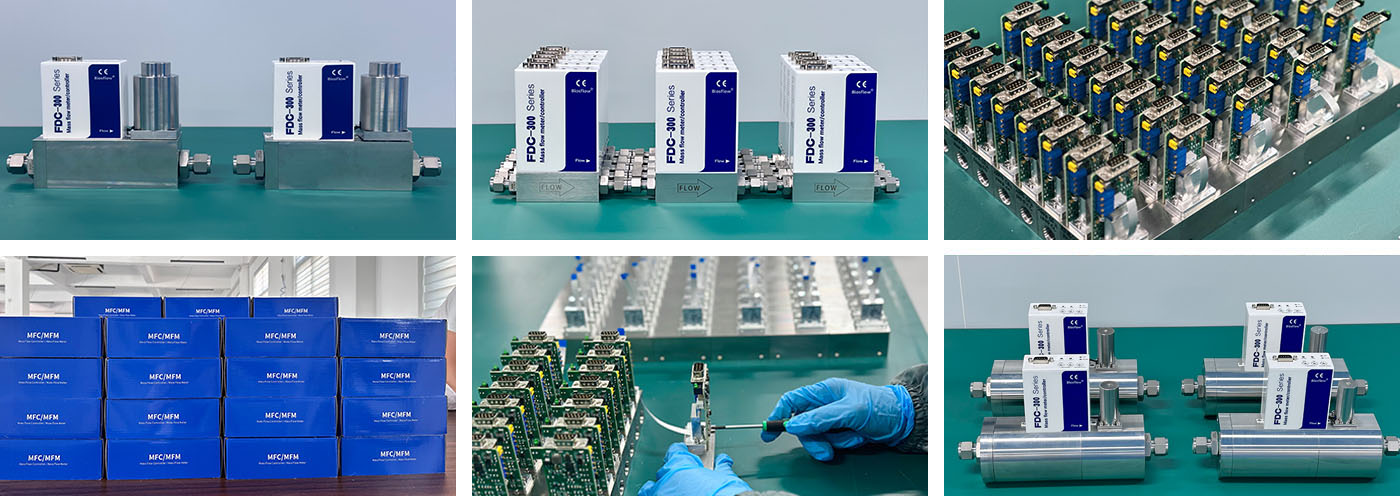
We understand that every customer’s situation is unique.Maybe you’re dealing with an unusual gas mixture. Maybe you need a specific flow range that’s not off-the-shelf. Maybe your system operates at a pressure that requires special attention. Whether your priority is affordability or performance, we’re here to help you find the right solution—one that offers not just the lowest price, but the best overall value for your application.
For more information, please visit our official website: https://www.biosflows.com/.
For a detailed and accurate quotation, please contact our 24/7 support specialist at WhatsApp +86 15138465679 or email Alexa@biosflows.com.
We look forward to serving you.
Contact Us
Related Products